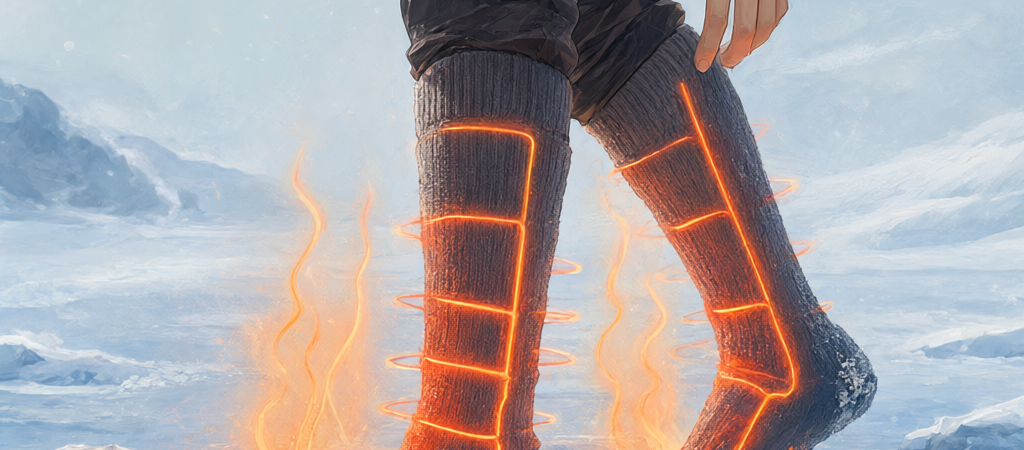
Cold feet end ski days early, cut hunts short, and make commutes miserable, and a thicker jacket does nothing to fix them. Heated socks solve the exact problem, but buying the right pair means understanding four things most product pages explain badly: how the sock should fit your foot and calf, which battery system matches your day, where the heat actually goes, and how you control it. This guide teaches those four decisions in plain terms, then shows six real socks that represent the main buying lanes, from a budget test drive pair to a vehicle powered rider liner.
Heated Jacket Guide is reader-supported. When you buy through links on our site, we may earn an affiliate commission at no extra cost to you.
Affiliate disclosure: Heated Jacket Guide is an Amazon Associate and earns from qualifying purchases. This is a research-based guide. We did not personally test these socks. Every spec below comes from manufacturer pages and live retailer listings checked in September 2026. Prices move with the season, so check the current price on Amazon before you buy.
The short version: six socks that cover every buyer
If you want the recommendation first, here it is. Most buyers should start with the Snow Deer upgraded heated socks, the 7.4V value standard with whole toe heat. Skiers who live in boots should look at the Savior Heat ski socks for the cushioned boot ready build and the battery level display. Commuters and everyday wearers who want a slimmer system should look at the ActionHeat 3.7V socks 2.0. Feature hunters who hate bending over to adjust heat should look at the Dr.Warm wireless socks with the remote control. Motorcycle and snowmobile riders should skip batteries entirely with the Gerbing 12V sock liners. Budget buyers who want to test the concept for the least money should look at the Surgoal socks with their huge claimed runtime. Read on for why each pick makes sense, and how fit, batteries, heat placement, and controls should drive your choice.
A note on Lenz and Therm-ic. The two premium ski brands deserve a mention up front. Neither brand’s heated socks were buyable on Amazon when we checked on September 21, 2026. The one verified Amazon listing, a <a href=”https://www.amazon.com/dp/B0BLZMM1N2?tag=heatedjacketg-20″>Lenz 6.1 bundle with rcB 1400 batteries</a>, was marked currently unavailable, and we found no verified Amazon listing for Therm-ic heated socks at all. Stock comes and goes, so check current availability if you are set on either brand, and plan to buy through ski specialty shops in the meantime. Our Lenz vs Therm-ic heated socks comparison covers both systems in depth, and the Lenz sizing, fit, and battery guidance in the sections below still applies.
The six picks at a glance
| Sock | Battery system | Heat and runtime | Best for | Price |
|---|---|---|---|---|
| Snow Deer Upgraded Heated Socks | 7.4V, 2200mAh | Whole toe heat, 2 hrs high, 5 to 7 hrs low | Best overall value | Check the current price |
| SAVIOR HEAT Heated Ski Socks | 7.4V | Forefoot heat, 9 to 10 hrs low, battery display | Skiers and boot wearers | Check the current price |
| ActionHeat 3.7V Heated Socks 2.0 | 3.7V | Top of toe heat, 4 plus hrs high, 7 plus hrs low | Slim everyday system | Check the current price |
| Dr.Warm Wireless Heated Socks | 7.4V, 3000mAh | 149F max, 3.5 to 11 hrs, wireless remote | Remote control convenience | Check the current price |
| Gerbing 12V Heated Sock Liners | 12V vehicle power | 135F max, unlimited on bike power | Motorcycle and snowmobile riders | Check the current price |
| Surgoal Heated Socks | 8000mAh packs | Claimed 10 hrs low, UL and FCC certified | Budget test drive | Check the current price |
For the full product-by-product rankings, see our best heated socks roundup, our heated socks for skiing guide for slope specific picks, our best heated socks for women guide, and our heated socks sale page for current deals. If your problem is cold feet without wanting heated socks at all, our best heated insoles roundup covers the alternative.
Sock fit and calf sizing: start with your shoe size
Heated sock sizing starts from shoe size, not from a separate foot measurement. Most brands size in the familiar XS to XL range mapped to EU shoe sizes, and the premium brands publish the full chart. Lenz, the premium ski brand, sizes its Heat Sock 5.1 from XS (EU 31 to 34) through XL (EU 45 to 47), with S covering EU 35 to 38, M covering EU 39 to 41, and L covering EU 42 to 44. If you wear a US 9.5, you are an EU 42.5, which lands you in M on the Lenz chart. Check the chart for your brand rather than assuming your size, because the mapping is not identical everywhere.
Calf fit is the second decision. Lenz sells the Heat Sock 5.1 in both slim fit and regular fit, because the same foot size can sit on very different legs. The slim fit suits narrow feet and legs, while the regular fit adds improved elasticity in the calf area and suits stronger calves. If you have athletic calves or you wear the socks under tight ski boot shells, look for the regular cut or a brand that calls out calf elasticity. A knee high sock that binds at the calf will slide down all day, and a sliding sock puts the heating element in the wrong place.
Thickness decides which boots they fit. The Dr.Warm wireless socks are a 3mm build, which needs roomy boots. Thick cushioned socks like the Savior ski socks feel great in ski boots but can overheat mild days and crowd tight footwear. If you want heated socks for tight dress boots or cycling shoes, a thin liner style like the Gerbing 12V liners fits where a cushioned sock cannot.
Battery types and runtime: voltage is heat pressure, capacity is heat duration
7.4V is the mainstream standard. Most heated socks on Amazon run on 7.4V rechargeable lithium packs, and four of the six socks in the table above use them. A 7.4V system is the balance point the industry settled on: enough voltage to drive toe elements to real heat, with batteries small enough to ride on the sock cuff. When you compare socks, the capacity number in mAh matters more than the voltage number, because most brands use the same voltage.
Capacity in mAh sets your runtime. The Dr.Warm ships 3000mAh packs while the Snow Deer ships 2200mAh packs, and that gap shows up in the claimed runtimes: 3.5 to 11 hours depending on setting for Dr.Warm against 5 to 7 hours on low for Snow Deer. The Surgoal ships huge 8000mAh packs with a claimed 10 hours on low. Treat every manufacturer runtime as best case, on the lowest setting, in mild cold. Real winter shortens every number, and high heat can cut runtime to 2 to 4 hours on any sock here.
3.7V and 5V systems trade heat for slimness. ActionHeat builds its 3.7V socks 2.0 on a lighter voltage platform with slimmer batteries that sit more comfortably on the cuff. The published runtimes sit in a fair range, 4 plus hours on high and 7 plus on low, but the heat output ceiling sits below the 7.4V class. Buy 3.7V for everyday wear and light cold, not for deep winter days in the stand.
Premium proprietary packs are a different world. Lenz and Therm-ic sell the socks and the lithium packs separately, with multiple pack tiers like the Lenz rcB 1200, 1400, 1800, and 2000. The packs snap to the sock cuff with press studs and you pick the capacity that matches your day. The 5.1 sock with an rcB 2000 pack runs near $490 total, which buys superb engineering and app control, but you should know the full system cost before you fall in love with the sock alone.
12V systems belong on vehicles. Gerbing wires its sock liners into your motorcycle, snowmobile, or ATV electrical system for effectively unlimited runtime. Off the bike they need a separate battery harness, so do not buy a 12V liner as a general winter sock unless you ride.
Heat settings: where the heat goes matters more than the max
A sock that publishes 149F but only heats the arch will disappoint you, because toes get cold first. Look for heating elements that explicitly cover the toes: Snow Deer covers the whole toe with far infrared elements, Savior covers the forefoot above and below, ActionHeat heats the top of the toes, and Lenz uses a patented Toe Cap element that encloses the toes from above and below. Back of foot only heat is a weaker design for cold toes.
Three heat settings is the norm. High for the initial warmup, medium for steady cold, low for stretching battery through a full day. Snow Deer uses a simple color system on the sock button: red for high, white for medium, blue for low. A sock with fewer settings is simpler but gives you no way to trade heat for runtime when the day runs long.
Published temperatures are ceiling figures. Dr.Warm publishes a 149F max, Gerbing publishes 135F. Treat any max as a lab figure: wind, fit, battery age, and the insulation of your boot all pull it down. Coverage and runtime honesty matter more than the biggest number.
App vs button control: how you change the heat
The button on the sock is the default. Most heated socks change settings with a button on the battery pack or the sock cuff. It is simple and it always works, but it means pulling up your pant leg on the lift or in the stand.
Remotes remove the bend. The Dr.Warm wireless socks ship a remote control that adjusts heat without touching the sock, which is a small luxury that matters on cold days. Gobi Heat uses the same idea on its Tread socks.
Phone apps are the premium tier. Lenz controls its heat socks from a free smartphone app over Bluetooth, with infinitely variable adjustment, plus direct control on the lithium pack itself. App control is lovely, but it ties you to the brand ecosystem and adds cost. Decide whether you will actually use it: many buyers set one heat level in the morning and never touch it again.
Sock material and care: protect the wiring
Merino blends feel better. Premium heated socks use real wool in the mix: the Lenz 5.1 blends merino wool with silk and functional fibers for a breathable, fast drying, scratch free feel. Cotton blend socks feel familiar and soft for everyday wear. The material does not change the heat, but it changes whether you want to wear the socks for ten hours.
Always remove the batteries before washing. This is the rule every brand repeats, and ignoring it is how heating elements die. Lenz rates its socks machine washable at 30 degrees with the included laundry bag, and several mainstream brands allow gentle machine cycles. Snow Deer recommends hand washing only. When in doubt, hand wash in cool water with mild soap and air dry fully, then make sure the battery pockets are completely dry before the packs go back in.
Dry completely, store smart. Never use a dryer or radiator heat on heated socks. For summer storage, charge the packs to roughly half, keep them cool and dry, and top them up once mid summer so they do not sit depleted for months.
Snow Deer Upgraded Heated Socks: The Value Standard
The safe default for most buyers. These run on a 7.4V system with two 2200mAh rechargeable batteries, and the far infrared heating elements cover the whole toe area, which is exactly where ski boots steal warmth first. Three heat settings are selected with a button on the sock: red for high, white for medium, blue for low. The brand claims roughly 2 hours on high, 3 to 4.5 on medium, and 5 to 7 on low. Sizes run S through XL.
Who should skip it: high heat drains the pack in about 2 hours, so all day high heat users should look at Dr.Warm or plan on spare batteries. The listing specs differ slightly from the brand store on runtime, so treat the numbers as approximate either way.
Check the current Snow Deer sock price on AmazonSAVIOR HEAT Heated Socks: The Ski Boot Pick
The pick for people who live in ski boots. Savior builds these specifically for the boot: cushioned and padded at the heel and toe, with far infrared elements above and below the forefoot, plus a battery power display so you never guess how much heat you have left. Sizes run XS to XL for men, women, and kids per the brand. The 9 to 10 hour claimed low runtime is among the longest in the mainstream tier.
Who should skip it: the thick build can be too warm for mild days and crowds tight footwear. If you will never wear these inside a boot, the Snow Deer pair is simpler.
Check the current SAVIOR sock price on AmazonActionHeat 3.7V Heated Socks 2.0: The Slim Everyday Pick
The pick for everyday wear on a lighter system. These run on a 3.7V platform with slimmer batteries that sit more comfortably on the cuff, heat the top of the toes, and claim 4 plus hours on high and 7 plus on low. They are machine washable in the supplied laundry bag, which is a real convenience edge over hand wash only rivals.
Who should skip it: the 3.7V ceiling sits below the 7.4V class for deep winter output. Skiers and hunters facing real cold should step up to the Snow Deer or Savior picks above.
Check the current ActionHeat sock price on AmazonDr.Warm Wireless Heated Socks: The Remote Control Pick
The pick for people who refuse to bend over on the lift. The wireless remote adjusts heat without pulling up your pant leg, and the 7.4V 3000mAh batteries outsize most of the category. The published 149F max is the hottest figure in this guide, and the claimed runtime spans 3.5 to 11 hours depending on setting. Sizing covers men, women, and kids.
Who should skip it: the 3mm build needs roomy boots, and the low end of the runtime range shows how fast high heat drains any battery. Slim boot wearers should look at Snow Deer.
Check the current Dr.Warm sock price on AmazonGerbing 12V Heated Sock Liners: The Rider Pick
The pick for riders, full stop. These 12V liners plug into your motorcycle, snowmobile, or ATV electrical system, or into Gerbing pant liners, for effectively unlimited heat as long as the engine runs. The lifetime element warranty is unmatched in this guide. The published max is 135F.
Who should skip it: these are thin lycra liners, not cushioned socks, and off the bike you need Gerbing’s separate battery harness. Non riders should pick any of the battery socks above.
Check the current Gerbing liner price on AmazonSurgoal Heated Socks: The Budget Test Drive
The cheapest credible way to learn whether heated socks suit you. These ship two huge 8000mAh rechargeable batteries with a claimed 10 hours of runtime on low, and the batteries publish UL and FCC certifications, which is more transparency than most budget brands offer.
Who should skip it: the brand is newer with a thinner track record, and the 8000mAh packs are physically large on the cuff. Buyers who want a proven brand should step up to the Snow Deer pick.
Check the current Surgoal sock price on AmazonWhere to go next
This guide taught the buying logic. For ranked picks by activity, read our best heated socks roundup for the overall top seven, heated socks for skiing for slope specific picks, and best heated socks for women for women specific sizing and fit. Watch our heated socks sale page for seasonal deals. If your problem is cold feet without wanting heated socks at all, our best heated insoles roundup covers the alternative.
Frequently asked questions
What size heated socks should I buy?
Start from your shoe size and check the brand chart. Lenz maps XS to EU 31 to 34, S to 35 to 38, M to 39 to 41, L to 42 to 44, and XL to 45 to 47. If you are between sizes or you have strong calves, favor the larger size or the regular fit cut over the slim fit.
7.4V vs 3.7V heated socks: which is better?
For real outdoor cold, 7.4V. Higher voltage delivers faster heat up and more stable warmth when temperatures drop. The 3.7V ActionHeat system is slimmer and simpler for everyday wear, but it cannot match the 7.4V class for heat output. Riders can skip the debate with 12V Gerbing liners powered by the vehicle.
How long do heated sock batteries last?
On a 7.4V 2200mAh system, expect roughly 2 hours on high and 5 to 7 on low, with real winter shortening every figure. Bigger packs stretch further: the Surgoal claims 10 hours on low from its 8000mAh packs, and the Savior claims 9 to 10 on low. Plan your setting around your day: high for the warmup, low for the long haul.
Can you wash heated socks?
Usually yes, with the batteries removed. Lenz rates its socks machine washable at 30 degrees in the included laundry bag. Snow Deer recommends hand washing only. Check your model’s instructions, and always make sure the battery pockets are fully dry before the packs go back in.
Are expensive heated socks like Lenz worth it?
It depends on your use. The premium Lenz system buys you a merino and silk blend, a Toe Cap element that heats toes from above and below, and app control, but the batteries sell separately and the full system can run near $490. For most people, a $70 7.4V sock like the Snow Deer delivers the core benefit at a fraction of the price. Serious skiers who ski 50 plus days a season are the buyers who get the most from the premium tier.
Should I get heated socks or heated insoles?
Heated socks warm the whole foot and toes, which is better for cold that comes from the boot. Heated insoles warm from below and work in any shoe, but they do less for toe numbness. Many skiers with truly cold feet use both. Our best heated insoles roundup covers that option.
Sources
- Amazon listing pages for the six socks above, titles and specs verified September 2026
- christysports.com Lenz Heat Sock 5.1 Toe Cap product page: size chart, Toe Cap element, app control, battery sold separately
- tesmasport.com Lenz Heat Sock 5.1 product pages: slim vs regular fit, material mix, wash instructions, rcB battery packs
- the-high-route.com Lenz 5.1 heated socks review: sizing notes and full system pricing
- gokozywear.com heated vest fit guide: referenced for layering fit principles
- pipeline research records for drafts best-heated-socks and heated-socks-for-skiing